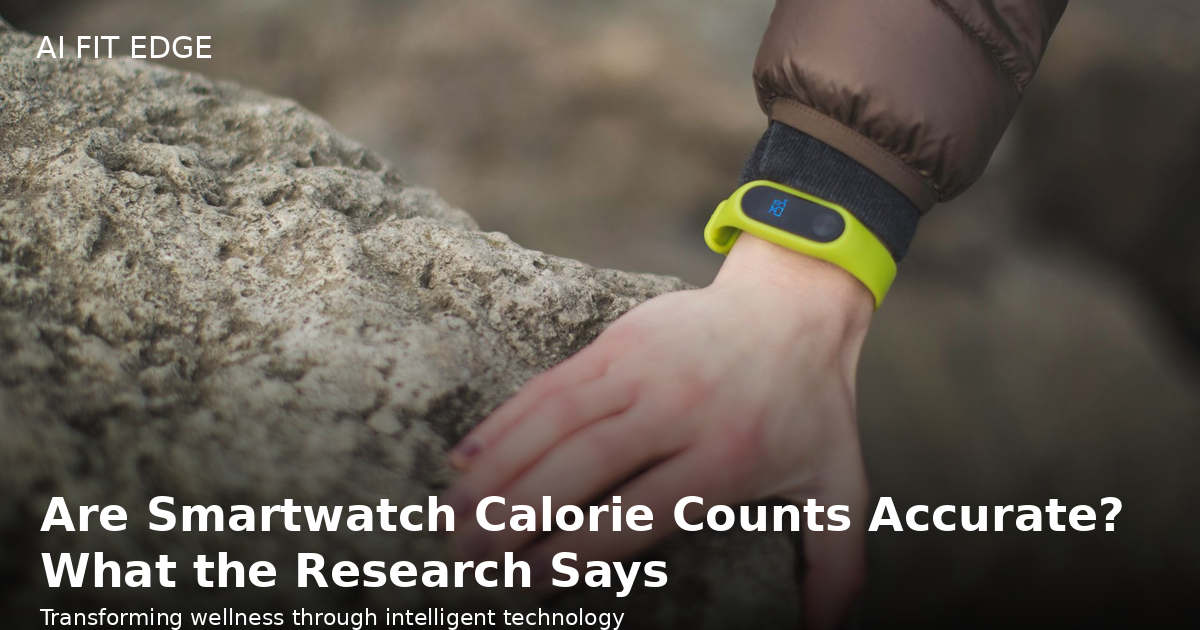
Every modern smartwatch proudly displays a number after your workout that claims to be the calories you burned. That number looks precise, sometimes down to a single digit, which makes it very tempting to trust. But how accurate is that figure really? Research into wrist worn calorie tracking tells a more honest and complicated story. The short version is that calorie estimates from smartwatches are the least reliable metric they produce, often overshooting by a meaningful margin, and that error varies a lot depending on the device, the activity, and the person wearing it. Understanding why gives you a much healthier relationship with the number on your wrist.
How a Watch Estimates Calories
A smartwatch cannot actually measure the calories your body burns. It measures motion and heart rate, then feeds those signals into an algorithm that estimates energy expenditure. Heart rate is the strongest input, because your heart beats faster as your body works harder. The watch combines your heart rate with your weight, height, age, and gender, which you entered during setup, to guess at how many calories each minute of activity costs.
This is a model, not a measurement. Models make assumptions, and those assumptions are built from averages of the general population. A person whose physiology matches the average will get a decent estimate. Anyone on the edges, with more muscle, more body fat, a higher baseline fitness level, or a different metabolic rate, will drift further from the guess the watch is making.
What the Research Actually Shows
Independent researchers have tested popular smartwatches against laboratory equipment that measures energy expenditure with real accuracy, such as indirect calorimetry. The results are consistently clear: heart rate accuracy is generally good, but calorie accuracy lags well behind. Several published studies found that wrist worn devices overestimate total daily energy expenditure, often by anywhere from ten to fourty percent depending on the condition.
The pattern is important. When researchers looked at different activities, the errors were not uniform. On a treadmill at a steady pace, where heart rate tracks effort cleanly, the estimates were usually closer. During weight training, interval work, or activities with lots of starts and stops, where heart rate lags behind the actual effort, the calorie figure drifted further. The harder and more varied the workout, the less you can trust the count.
Why Overestimation Is So Common
There are a few structural reasons smartwatches lean toward overcounting, and none of them is a conspiracy. First, a resting metabolism component is sometimes added into activity burns even when it should be counted separately. Second, the watch cannot distinguish heart rate driven by actual work from heart rate driven by stress, excitement, or heat. Third, the algorithms are tuned so that they are rarely embarrasingly low, because an accurate feeling estimate beats an obviously small one for user satisfaction.
Weight training deserves special mention. Your heart rate during a strength set does not fully reflect how much energy the session uses across the recovery period afterward. The watch only sees the elevated heart rate in the moment, missing part of the afterburn where your body keeps working to repair muscle and replenish stores. So a gym session is even more likely than a run to be overestimated.
How Big Is the Error in Real Life
To make this concrete, imagine a study subject exercises on a treadmill for thirty minutes. The lab says they burned three hundred calories. A popular watch might report three hundred and thirty, a modest overshoot you would never notice. On another day the same person does a bodyweight circuit, and the watch reports a burn forty percent higher than the lab measurement. Across a full day, the accumulated error means someone following the watch could believe they have eaten room for several hundred extra calories they never actually burned.
That matters most for anyone trying to lose weight. If you finish a workout, see a big calorie number, and reward yourself with a matching snack, you can easily undo the deficit that workout created. The watch has told you it is safe to eat more, and the research says that permission is frequently too generous.
How Accurate Is the Step Count and Heart Rate
It is fair to compare. Step counting and heart rate, the two measurements that feed the calorie estimate, are far more reliable on their own. Modern optical heart rate sensors track your pulse within a few beats per minute at steady state, which is good enough for training zones. Step count is decent for steady walking, though it drifts during pushing a cart, carrying a child, or other motions that move the arm without moving the legs.
The lesson is that the watch is an excellent overall tracker but a mediocre calorimeter. Its strong signals feed a weak estimate. When you treat calories as gospel, you are assigning precision to the least precise number the device produces. That is exactly backwards.
How to Use the Number Wisely
You do not need to throw the calorie figure away entirely. The smartest approach is to use it as a relative trend rather than an absolute truth. Your days are probably similar, so a day where your watch says you burned more than usual really did involve more activity. The direction and the change are useful, even when the absolute number is unreliable.
- Treat calorie counts as a rough directional signal, not a precise measurement.
- Never base a meal on the exact calorie number a workout shows.
- For weight loss, focus on the food side of the equation where you control the data.
- Use the watch to estimate relative effort and trending daily activity.
- Consider your personal overestimation tendency if you are logging for weight management.
How to Calibrate Your Watch So It Gets Closer
While no consumer watch will match lab equipment, you can make your device more personal and slightly reduce the error. The largest lever is the accuracy of the profile information you enter. If your weight has changed since setup, update it, because the algorithm depends on it. Choose your activity level honestly when the watch or app asks, rather than flattering it into assuming you train like an endurance athlete when you are just starting out.
Some modern devices offer a period of personalization that tunes the resting heart rate and daily activity baselines to your actual data. Give the watch a couple of weeks of normal wear before you trust its calorie number deeply. The algorithms learn your typical ranges, and a watch that knows your real resting heart rate and daily step average produces more sensible estimates than a fresh one guessing from population averages. Keeping your age, weight, and height current is the cheapest accuracy you can buy.
Should You Trust Calories for Cutting or Bulking
The answer depends on how you use the number. As a target you eat to exactly, calories from a watch are a hazard, because the overestimate grants you too much food freedom. As a comparative tool across your own days, calories are useful, because a heavier workout genuinely does demand more fuel. The practical middle ground is to log your food precisely and let the watch be a tiebreaker for activity, nudging you to eat a little more on hard training days and a little less on rest days.
Athletes chasing a lean bulk or a cut usually find it more reliable to adjust based on the scale and how their clothes fit over a couple of weeks than to chase the watch number in real time. Your body weight trend is a real measurement, unlike a model generated calorie guess. Use the watch for structure and motivation, but let body composition trends and honest food logging carry the decisions that actually move your goals.
The Bottom Line
Smartwatch calorie counts are the weakest metric on modern fitness wearables. Heart rate and steps are reasonably accurate, but the calorie number built on top of them regularly overshoots by ten to fourty percent, especially during strength and interval training. The number feels precise because it appears with confidence and a single digit, but precision is not the same as accuracy.
Use the calorie figure as a rough daily trend, never as a license to eat a matching amount of food. Track your nutrition on the side you actually control, and let the watch guide relative effort instead of absolute truth. When you stop treating the number on your wrist as a precise measurement and start treating it as a helpful estimate, it becomes a far more honest and useful training partner.