Walk into a newly built or freshly renovated fitness club in 2026 and you will notice the layout looks nothing like the gyms many people grew up with. Recovery pods sit near the entrance. Cable machines carry touchscreens that talk to a central platform. The resistance stack adjusts itself based on the weights you handled last week. Cardio decks are woven into the same space instead of being pushed to a back wall. None of this is decoration. It is the result of a simple idea that has quietly reshaped the industry: a training floor that learns about you can deliver better results than one that treats every member the same. This guide walks through what genuinely belongs on the fitness floor of the future, what moves the needle for your training, and how to separate real upgrades from gadget noise.
The Shift From Equipment to Feedback Loops

For decades a gym defined itself by what hardware it owned. More racks, more machines, more square feet equaled a better club. That model is giving way to a different mental frame. Modern facilities increasingly treat the floor as a feedback loop. Every rep you complete, every interval you hold, every minute of recovery you log feeds into a profile that the equipment and the coaching staff can use to shape your next effort.
This is where artificial intelligence enters the picture in a usable way. The most advanced strength machines estimate your range of motion and tempo. Cardio machines compare your current session to your baseline and adjust the target. Recovery technology reads your resting heart rate and sleep quality and tells you whether today is a push day or a lighter session. None of these tools replaces a workout plan. They sharpen it, the way a good coach sharpens a training block by watching you rather than guessing about you.
For the person training, the practical payoff is consistency. The feedback loop catches small problems early. A plateau that used to hide for weeks becomes visible in a few sessions. You stop guessing whether you are overtraining, because the data on the floor and on your wrist agrees on the answer.
Smart Strength and Cardio That Adapts to You
Strength training has always been simple to describe. Lift a weight, recover, lift a little more. The difficulty was always in the details such as tempo, depth, rest length, and when to progress. Smart strength machines attack exactly those details.
- Connected cable stacks and plate loaded machines record every set, so your next visit starts with a recommendation instead of a guess.
- Camera based systems observe your rep speed and depth and flag form drift before it becomes a loading injury.
- Adaptive resistance adjusts the weight through a set based on your fatigue curve, letting you grind out quality reps near the end of a set without spotter guesswork.
- Digital dumbbells and adjustable benches log the full session profile so your app and the gym floor agree on your workload.
You should treat the claims behind this hardware with healthy skepticism. Some of it is genuinely useful. Some of it is a screen bolted to an otherwise ordinary machine. The honest rule of thumb is that the value comes from the tracking and the coaching logic, not from the size of the display. A machine that logs your data and feeds a plan is an upgrade. A machine that simply shows you an animated video is not.
Cardio is undergoing a similar change. Interactive treadmills, rowers, and bikes now offer terrain simulation, structured interval profiles, and race against your own history. The important shift is from counting distance alone to measuring output and recovery between intervals. You are no longer just running for a set number of minutes. You are running in a bracket that the system recalibrates to your current fitness, which keeps hard sessions honest and easy days genuinely easy.
Recovery Belongs on the Floor, Not in a Corner
The biggest single change in facility design over the last few years is where recovery sits. It used to be an afterthought or an expensive add on. Now it is treated as part of the training surface itself. New buildouts frequently place compressors, contrast baths, sauna rooms, and massage stations at the heart of the floor rather than in a separate dark wing.
There are two reasons this matters for you. The first is practical. Recovery infrastructure changes how you schedule training. If your gym offers credible recovery tools, you can plan harder sessions knowing you have a realistic way to speed up the reset. That is not a luxury. It is a training variable. The second reason is that recovery tools now produce data that influence the rest of your program. A readiness score derived from your resting heart rate and overnight recovery can tell you whether that leg day yesterday left you ready for another push or whether a short walk and mobility work is the smarter choice.
Be realistic about what recovery gadgets can promise. Contrast baths and massage feel excellent and support how you feel, but they do not replace sleep, hydration, and protein. The best floors treat recovery as part of the plan and never as a substitute for the fundamentals.
Wearables Create a Single Source of Truth
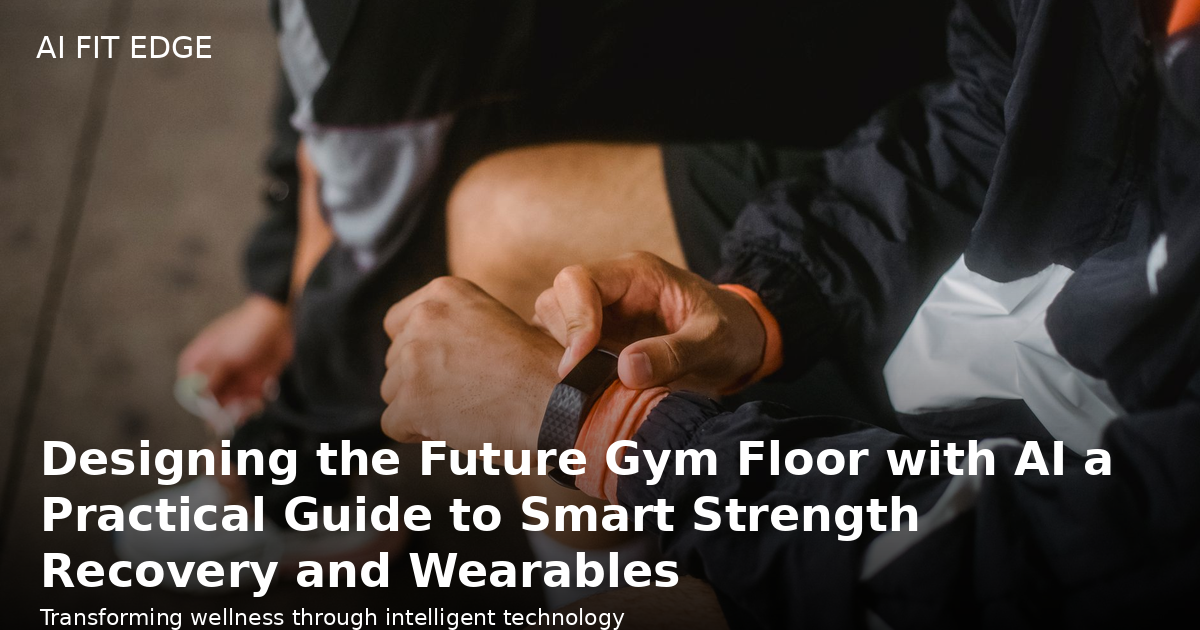
The modern training floor rarely stands alone. It connects to the wearable on your wrist or finger. Your smart ring, watch, or tracker becomes the bridge between your life outside the gym and the work you do inside it. That integration is the core of the AI fitness approach that works in practice.
When your wearable talks to the gym platform, a few powerful things happen. Your readiness for the day is visible before you arrive. Your sleep from the night before gets factored into the suggested load for a session. Your heart rate variability and resting heart rate create a trend line that catches overtraining earlier than your mood will. The equipment can even adjust the session you start based on that signal, so a genuinely tough day does not begin with an impossible workout.
You should trust these signals with an open mind and a grounded one. Wearables are good at measuring trends and remarkably accurate at heart rate. They are less reliable at the exact numbers that marketing tends to emphasize, such as precise calorie burn or a single magic readiness number. The useful mental model is to watch the trend over weeks, not to obsess over any single morning reading. A drop across several days is a real signal. One odd number is noise.
AI Coaching and Why the Human Element Still Wins
It is worth being direct about what AI coaching does well and where it falls short, because honesty protects you from disappointment. The pieces artificial intelligence handles impressively are progression logic, plateaus, consistency, and reminders. A system can review your last dozen sessions, notice that your squat volume has stalled, and adjust the next block automatically. It can prompt you to keep the habit alive on days you would otherwise skip. That kind of tireless, data driven administration is a genuine benefit.
What AI still cannot do is replace the human coach. A living coach sees the small hesitation in your movement, knows your history beyond the numbers, and adjusts on the fly when a joint hurts or your motivation is low. They provide the accountability and the judgment that makes a plan safe. The future floor gets this right by pairing the two. Artificial intelligence handles the pattern recognition and the busywork, while a human trainer handles safety, technique, and the relationship that keeps you coming back.
The facilities that understand this will not try to sell you on eliminating staff. They will use technology to let each coach do more, by offloading data collection and program math. That is the configuration that actually serves you.
Common Mistakes When a Gym Adds Technology
Not every upgrade is an improvement. Facility owners and members alike get burned by the same patterns. Knowing these in advance helps you judge a gym and helps you use one honestly.
- Buying screens over substance. The most expensive mistake is decorating machines with flashy displays while the underlying programming logic stays generic. The question to ask is whether the tech changes the workout, not whether it looks impressive.
- Collecting data nobody uses. A floor full of sensors is worthless if the data never reaches the coach or the member in a usable form. Integration matters more than sheer volume of numbers.
- Ignoring maintenance. Connected hardware ages fast. A gym that cannot keep its sensors calibrated and its platforms updated slowly accrues broken promises and frustrated members.
- Skipping training for staff. The best technology in the world fails if the front line staff cannot explain it or route its output into coaching. People adopt tools they understand.
- Trusting unverified marketing claims. Some vendors quote dramatic results that are hard to reproduce outside controlled settings. Treat bold claims as a reason to test, not as a reason to buy.
For you as a member, these patterns translate into a quick checklist. Does the tech integrate with a plan you can follow? Does the staff understand the data? Can you see your own progress in one place? If the answer to those questions is yes, the floor is probably worth your investment.
A Practical Blueprint for Your Next Upgrade
Whether you are a club owner planning a renovation or an individual deciding how much technology to trust, a sensible sequence keeps your money and energy pointed at what works.
- Start with the tracking layer. A reliable way to log your strength and cardio sessions should come first, because everything else builds on that foundation.
- Add the recovery variable. Once your training data is real, layer in sleep and heart rate variability so you can steer load by readiness rather than by feel alone.
- Introduce adaptivity. Use equipment and programming that adjusts based on your recorded history, so each session continues from the last one instead of starting over.
- Keep a human in the loop. Use artificial intelligence for the pattern detection and the busywork, while a coach owns technique, safety, and motivation.
- Review the evidence. Check your own results after a few weeks rather than trusting a marketing number. The floor that works is the one that shows improvement you can measure.
The future fitness floor is not about replacing dumbbells with gadgets and it is not a science fair of disconnected screens. It is a system that responds to you. The smartest version of this floor is simple at the surface and sophisticated underneath. It logs what you do, it factors in how you recovered, it adapts the next session, and it keeps a knowledgeable human between you and any mistake.
You do not need every piece of technology to benefit from the trend. Even a modest setup, a good tracking app, a wearable you trust, and a coach who reads the data, will get you most of the way. Start with a small loop you can actually maintain. Watch the trend over a few weeks. Add capability only when the existing piece has become routine. That measured approach is how you build a training floor, whether it is in a commercial club or in the corner of your home, that genuinely earns your trust and your results.