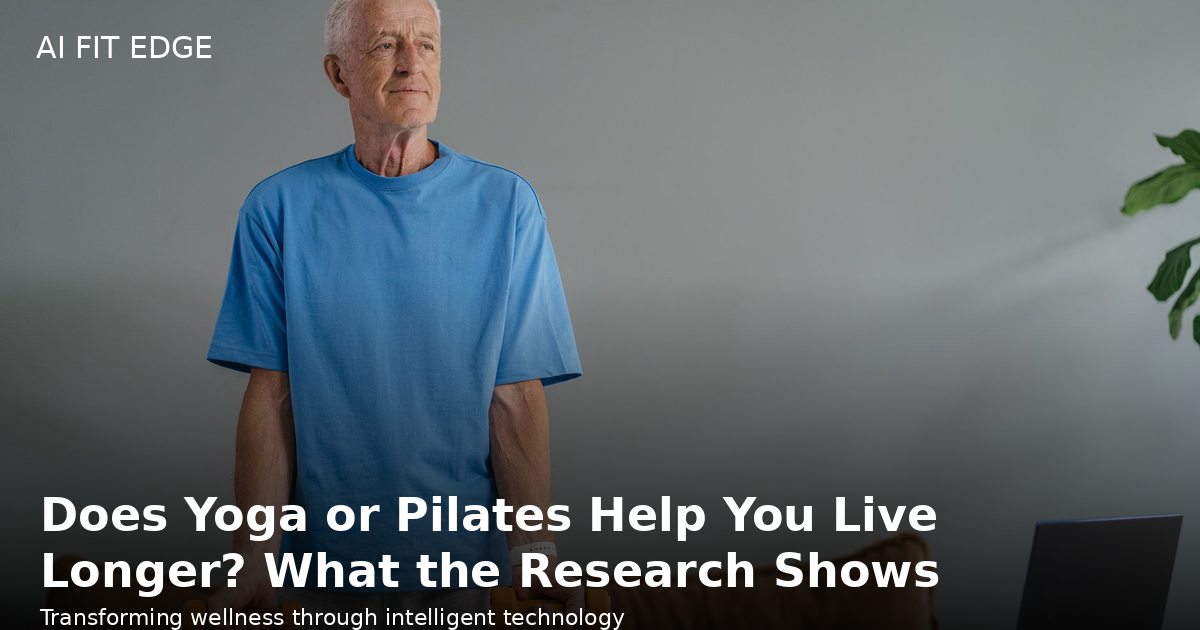
Does Yoga or Pilates Help You Live Longer?
If you have spent any time scrolling through wellness content lately, you have probably noticed the same pattern. One person swears by cold plunges, another by red light therapy, and a third by a cabinet full of peptides and specialized supplements. Everyone in your feed seems convinced their favorite practice is the secret to living longer, yet very little of it rests on solid evidence. That is why a new study from Arizona State University is worth paying attention to. Researchers there looked at 21 popular alternative health practices and asked a straightforward question: which ones are actually linked to living longer? The answer surprised plenty of people in the wellness world. Of all 21 practices they examined, only two showed a genuinely meaningful association with a lower risk of death, and they were not the exotic therapies dominating social media. They were yoga and Pilates.
If you are trying to make sensible decisions about your healthspan rather than chasing the next trend, this study gives you a grounded place to start. Let us walk through what the researchers found, why movement appears to win, and how you can build your own evidence based longevity routine without falling for the hype.
What the Study Actually Found
The Arizona State research team pulled from nationally representative data covering more than 55,000 American adults. They linked that information to mortality records over roughly a decade, then compared people who used each of 21 alternative health practices against people who did not. The list included acupuncture, chiropractic care, specialized diets, and a range of other complementary and alternative medicine options that millions of people spend real money on every year.
After controlling for factors such as income, education, exercise habits, smoking, body mass index, and self rated health, only two practices stood out statistically: yoga and Pilates. Yoga was associated with a 27 percent lower risk of death, and Pilates was associated with a 36 percent lower risk. Those are meaningful numbers, especially when you consider how broad the comparison was.
The study co author, Arizona State associate professor Connor Sheehan, framed it simply. Of all the alternative practices people are spending on, the two with the strongest longevity signal are rooted in physical movement, not the more exotic sounding therapies. That phrasing matters because it cuts against a lot of current wellness marketing that sells supplements and devices as the route to a longer life while treating exercise as an afterthought.
Why Movement Keeps Winning Over the Exotic Stuff
It is tempting to look for a shortcut, and the wellness industry knows this. Americans now spend billions of dollars each year on complementary and alternative medicine, and more than four in ten adults report using at least one such practice, from acupuncture to chiropractic care to specialty diet programs. Yet as the researchers point out, we actually know very little about whether most of these practices are associated with living longer at all.
The same cannot be said for regular physical activity. Exercise has one of the longest and most consistent evidence trails in all of health research, linking movement to lower risks of heart disease, diabetes, certain cancers, cognitive decline, and premature death. Yoga and Pilates sit squarely inside that larger body of evidence. They are forms of structured, repeated physical activity, and they happen to be approachable enough for a wide range of ages and fitness levels. That accessibility is likely part of why they show up so strongly in a general population study.
Another important point is that yoga and Pilates do more than burn calories. When you practice them consistently, you are not just moving; you are training several systems at once. That combination appears to be what makes them so durable over a lifetime.
Take strength and balance first. Both practices build muscle strength and improve balance, which matters far more for longevity than most people realize. Falls are a leading cause of serious injury among older adults, and declining muscle mass is strongly linked to frailty, metabolic slowdown, and loss of independence. Movements such as planks, bridges, lunges, and the many standing balance poses in yoga keep your joints and supporting muscles engaged well into your later decades.
Then consider cardiovascular fitness. Vinyasa flow, sun salutations, and faster paced Pilates sequences can raise your heart rate enough to count as meaningful cardiovascular work. Better aerobic fitness is one of the most robust predictors of a longer, healthier life, so a practice that works your heart while also working your muscles gives you two rewards from a single session.
And there is the quieter advantage of breath work and stress reduction. One of the strongest benefits of yoga and Pilates is their emphasis on controlled breathing. Deliberate breath work has documented effects on inflammation and heart function, and it helps quiet the stress response that, when chronic, wears the body down over time. You are essentially training your nervous system to recover, which is a longevity skill in its own right.
The Community Benefit You Should Not Ignore
There is a social dimension that the researchers highlighted as well. When you practice in a class rather than alone at home, you add a community component that research increasingly links to longevity. Loneliness and social isolation are associated with poorer health outcomes across a wide range of studies, and regular group movement gives you a natural, repeated reason to connect with other people.
As Sheehan put it, you are potentially getting physical activity, stress management, and community all wrapped into one practice. That combination is genuinely hard to beat, and it helps explain why yoga and Pilates stand apart from the solo supplement protocols that dominate so much wellness content.
The Honest Caveats You Should Keep in Mind
Before you book a reformer class and assume your longevity problem is solved, you should understand the limits of this kind of research. The finding is an association, not proof of causation. People who practice yoga and Pilates on a regular basis tend to be different from people who do not, even after the researchers controlled for income, education, exercise, smoking, and body mass index.
There is no way to fully rule out what researchers call the healthy user effect. Maybe the sickest people are simply too unhealthy to practice yoga or Pilates in the first place, which would make the practices look protective when they are really just excluding the least healthy individuals. People who regularly attend classes may also have better access to healthcare, more favorable genetics, or a general habit of taking better care of themselves.
None of that means the finding is useless. It just means you should treat yoga and Pilates as excellent, evidence backed components of a healthy life rather than magical guarantees. The same study could not say the same about most of the other 19 practices it tested, which is itself a useful takeaway in a world full of expensive wellness claims.
How to Build Your Own Evidence Based Longevity Routine
You do not need a drastic overhaul to start moving in a more longevity friendly direction. Here are practical, realistic steps you can take this week.
- Start with two sessions per week. The research does not demand a daily marathon. Two consistent yoga or Pilates sessions each week is a realistic on ramp that still delivers meaningful movement, balance work, and stress relief.
- Choose the style you will stick with. A beginner friendly hatha or gentle vinyasa class, a mat Pilates routine, or a reformer session all qualify. The best practice is the one you actually show up for repeatedly over years, not the one that looks most intense.
- Include it in a broader weekly mix. Yoga and Pilates are powerful, but variety still matters. Pair them with walking, strength training, or cycling so you hit cardiovascular, muscular, and mobility needs from different angles.
- Prefer group classes when you can. The community benefit is real and well documented. If a live class feels intimidating, try an in person beginner session or a consistent online group that still gives you a sense of connection.
- Add breath work even on non class days. A few minutes of slow, controlled breathing in the morning or before bed costs nothing and supports recovery and stress management every single day.
- Track your consistency, not your intensity. Use a simple calendar or a wearable to log your sessions. Longevity is built through months and years of dependable movement, so focus on showing up rather than pushing yourself to the limit.
If you already lift weights or run, do not see this as a reason to stop. Yoga and Pilates work well as complements to any existing routine because they strengthen the stabilizer muscles, improve flexibility, and promote the kind of recovery that hard training requires. Many athletes use these practices specifically to balance out the tightness and imbalances that sport alone creates.
The Bottom Line
In a field crowded with expensive and unproven longevity protocols, the Arizona State findings are refreshingly straightforward. When researchers examined 21 alternative health practices, yoga and Pilates were the only two meaningfully linked to a lower risk of death. They combine physical activity, strength and balance training, breath work, stress reduction, and often a social component, all of which are individually supported by a wide evidence base.
The honest caveat is that association is not causation, and the healthy user effect can never be fully excluded. But you do not need certainty to act sensibly here. You can build a healthspan strategy that is grounded in what the research actually supports: regular movement that you enjoy enough to sustain, in a format that also helps you recover and connect with others. Yoga and Pilates are an excellent, approachable foundation for exactly that. And if you are still curious about cold plunges, red light therapy, or peptide stacks, by all means explore them, but treat them as experiments and hobbies rather than replacing the movement that the evidence consistently rewards.
Your takeaway is simple. You do not need to chase the trendiest longevity therapy to improve your odds. Consistent, strength building, stress reducing movement in a community you enjoy is one of the best evidence backed investments you can make in a longer, healthier life.