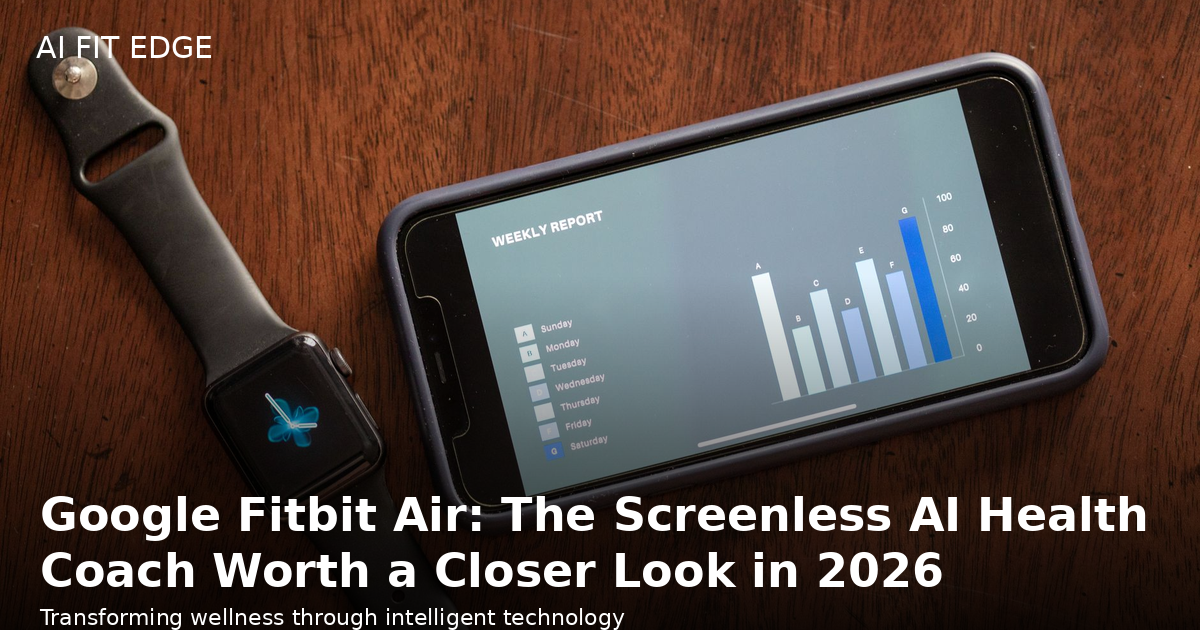
The wearable market finally has a product most people can buy without thinking twice. For years the screenless fitness tracker category was ruled by expensive subscription devices that cost more per year than many people spend on a whole smartphone. The Google Fitbit Air changes that by packing serious health sensors and an AI health coach into a small screen free band that costs less than a solid meal out, with no mandatory subscription to unlock the basics.
As someone trying to get quieter, deeper, more honest data about training rather than another glowing screen demanding attention, the Fitbit Air demands a closer look. This review covers exactly what it tracks, how the Gemini powered AI coach works, what the subscription actually buys you, and the honest caveats to weigh before you decide whether it belongs on your wrist.
What the Fitbit Air Actually Is and Who It Was Built For
The Fitbit Air is a lightweight screen free fitness tracker roughly the size of a small pebble. There is no display at all, no notifications flooding your morning, and no reason to look at your wrist mid set. You wear the soft band all day and overnight, and all the interesting information lives in the Google Health app on your phone.
Google positioned the Air as the answer to a question most companies avoid asking: what if you just want to know how your body is doing without adding another screen to your life? That framing matters because it changes what the device optimizes for. It does not try to be a mini smartwatch. It tries to be a quiet 24 hour sensor with coaching on the other end.
The target buyer is not the person who wants to reply to texts from their wrist. It is the person who wants continuous recovery and readiness data, wants more structured workouts, and does not want to pay a separate yearly fee just to see their own heart rate. That last point, the absence of an enforced subscription, is the single biggest reason the Air stands apart from its most famous screenless rivals.
The Sensors and Metrics You Get Around the Clock
Strip away the marketing and the Fitbit Air is a dense sensor package under a soft band. You get continuous heart rate monitoring, heart rate variability or HRV, blood oxygen or SpO2, skin temperature, and sleep staging. It also auto detects common workouts while you exercise and logs them with a recap sent to the Google Health app.
The practical value of these sensors shows up in a few reliable ways:
- Daily Readiness Score, which combines your overnight sleep quality, resting heart rate, and HRV to judge whether your body is ready for a hard session or needs to prioritize recovery
- Sleep analysis that separates light, deep, and REM stages so you can spot the nights where recovery actually fell short
- Resting heart rate trends that rise during illness or overtraining and drift back down as you recover
- HRV trends that act as an early signal for stress accumulation, travel, and sleep debt
- Recovery feedback in the morning on whether to push hard or back off
- Automatic workout detection that improves and personalizes the more you move
One thing reviewers consistently praise is that the readiness and recovery signals actually line up with how people feel on a given morning. When the sleep was poor and HRV dropped, the Air told users to ease off, and more often than not that matched the physical reality. That alignment between the number on screen and the feeling in the body is the real test of a recovery wearable, and the Air generally passes it.
The Gemini Powered AI Coach Inside Google Health
The flashiest feature is the Google Health Coach, a conversational assistant built on Google technology. In the premium tier it creates personalized fitness plans, suggests workouts, answers questions about your latest data, and offers sleep and readiness guidance in a chat style interface rather than a wall of confusing charts.
This use of AI is more than a gimmick because it converts raw sensor data into plain language decisions. Instead of staring at a heart rate graph and wondering what to do, you can ask questions directly and get an understandable answer that references your actual numbers. The coach factors in your history, your stated goals, and your readiness to form recommendations.
Practical ways people actually use the AI coach:
- Asking what to do when HRV drops several nights in a row and getting a suggestion to shift to easier work
- Getting a workout plan built around your available time and current readiness rather than a generic template
- Snapping a photo of cardio work and having the coach interpret the workout into a training log
- Asking for a plain language summary of last weeks sleep when you are too tired to parse the charts
- Receiving nudges when skin temperature or resting heart rate trends suggest you may be coming down with something
The caveat is that the most useful AI coaching lives behind the premium subscription. The free tier still gives you the full sensor data and the readiness score, which alone justifies the device. The AI coach and the richer personalized plans unlock with Google Health Premium, and you get three months of that free when you buy the Air.
Price, Subscription, and the Honest Value Math
Here is where the Fitbit Air does something genuinely rare in this category. The standard model costs around one hundred dollars, which is dramatically cheaper than its main screenless competitors. You can wear it, get continuous heart rate, sleep, HRV, and readiness data, and never pay another fee. The core device is not held hostage by a subscription.
Compare that to the alternative devices that made the category famous. One leading rival cannot be used at all without a yearly subscription that runs a few hundred dollars a year. Another lets you buy the hardware but leaves the most valuable data locked behind a smaller yearly fee. The Fitbit Air gives you the fundamentals free and reserves the AI coaching for a voluntary premium plan currently around ten dollars a month when it kicks in after the trial.
That pricing structure changes the decision math for two groups. For the casual exerciser who wants sleep and readiness data without recurring costs, the Air wins on price almost immediately. For the serious coach or athlete who wants the full AI coach experience, the premium plan is still cheaper than the enforced subscriptions of the status quo. You can start cheap, decide later, and never pay unless the AI layer feels worth it.
One more practical note is that the device uses a fast charge that tops up quickly, and the battery stretches up to about a week of typical use. For sleep tracking fans that removes the daily charging ritual that killed so many older trackers.
How the Fitbit Air Stacks Up Against Whoop and the Smart Ring
The screen free category is dominated by a subscription band and a smart ring, and the Fitbit Air lands squarely between them as the first option that is both affordable and subscription optional.
Against the subscription band, the Fitbit Air trades some sampling frequency and brand prestige for a radically lower price and no forced fee. It offers similar day to day usefulness in readiness, sleep, and HRV, which is what most people actually need. If your only hesitation about that other band was the yearly cost, the Air removes the objection entirely.
Against the smart ring, the Air trades discreetness for a more flexible sensor package and a far lower entry price. Rings are comfortable for sleep but can be awkward for intense strength work and are typically much more expensive. A band also gives you a more forgiving fit when your fingers swell or when you want to wear something hand friendly during heavy lifts.
Where the Air does not always win is in raw sensor fidelity at the extreme end. Power users who want the densest sampling for training load decisions may still prefer a higher priced band. But for the person who wants honest daily recovery signals without a monthly bill, the Air is now the clearest recommendation in the category.
Honest Caveats and Common Mistakes to Watch For
No wearable is perfect, and the Air has a few genuine rough edges worth knowing before you buy.
- First setup can be finicky, with some users reporting a stuck onboarding screen that needs an app restart, so budget a little patience for day one
- Occasionally the sleep score may not appear on a night when the battery is low or the band is too loose, so keep the fit snug and topped up before bed
- The full AI coach experience requires the premium subscription, so clarify before you buy whether you want the free readiness layer or the full coaching tier
- The Google Health app is still being polished and some find the interface visually uninspiring compared to its rivals, though the underlying data is strong
- You need to wear the device for several nights before the first Daily Readiness Score appears, so do not judge it on day one
- If you only care about step counting and notifications, a smartwatch is still the better fit, the Air is for recovery and readiness minded users
The most common mistake people make is judging the device too early. Readiness data works on trends, not single nights. One poor score means little. What matters is the pattern over weeks, and that is exactly where an always on sensor like this earns its keep.
Should You Buy the Fitbit Air
Recommend the Fitbit Air if you want continuous heart rate, sleep, HRV, and readiness data without paying a forced subscription, if you are tired of screen based distractions while training, or if you want an affordable on ramp into serious recovery tracking. It is also a strong pick for anyone upgrading from an older basic tracker who wants smarter insights without jumping to a four figure necklace or ring.
Look elsewhere if you need a full smartwatch experience with maps, music, payments, and notifications on your wrist. The Air is deliberately not that. And if you demand the densest possible sensor sampling for high level athletic load decisions, a pricier specialist band is worth the premium.
For the vast middle of people who want to train smarter, recover better, and understand their body in plain language, the Fitbit Air is the most balanced screenless wearable of the year. It makes AI powered health coaching financially realistic for the first time, and it proves you can get premium recovery data without building your training around a recurring bill.