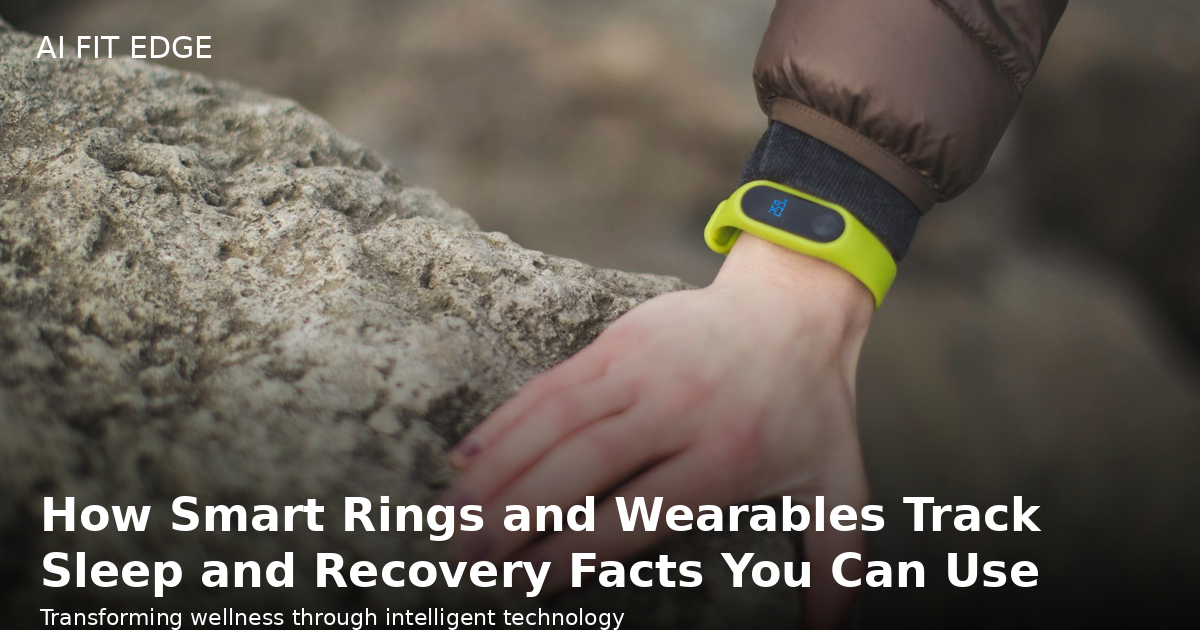
Smart rings and fitness watches have moved well beyond step counting. In 2026 people wear them to understand their sleep, their readiness to train, and the small daily signals that predict how their bodies will perform. The promise is appealing, but the details matter. Do these devices really measure what they claim? How should you read a recovery score? And how much should you let a gadget change your training decisions? This guide separates what the metrics actually mean from the marketing, and gives you a practical way to use the data without becoming a slave to your watch.
What These Devices Actually Measure

Sleep tracking devices analyze movement and heart signals throughout the night. A wrist worn watch uses an accelerometer to detect movement and an optical sensor to measure your pulse. A smart ring does the same thing from your finger. Together these signals let the device estimate how long you slept and, in most cases, how much time you spent in each sleep stage.
Heart rate variability, commonly called HRV, is measured the same way and is one of the most informative signals available. HRV reflects the variation in time between each heartbeat. A higher HRV generally signals that your body has recovered and is ready for a challenge, while a low HRV suggests accumulated stress or insufficient recovery. Resting heart rate, which is your pulse while completely at rest, is another core signal that tends to trend higher with stress and lower as fitness improves.
How Accurate Is the Sleep Data
Consumer wearables are good at detecting when you are asleep, but they are less precise at dividing that sleep into stages. Research has shown that rings and watches can be reasonably accurate at identifying light versus deep sleep and reasonably consistent across nights from the same device. That consistency matters more than raw accuracy, because it means you can trust the trends even if the absolute numbers are not lab grade.
What these devices are not is a medical sleep study. They cannot diagnose sleep apnea and they can occasionally misread a restless night, a partner moving, or a nap. The honest way to use the data is to look at trends over many nights rather than any single night. A device that consistently shows you are getting short, broken sleep is a useful signal. One night where the score looks odd is usually noise.
Reading a Recovery or Readiness Score
Most platforms compress their data into a single daily recovery or readiness score. Understanding what that number represents helps you use it well. The score is typically built from HRV, resting heart rate, sleep, and sometimes activity history from the previous days. A high score is meant to suggest you are ready to train hard, while a low score suggests you should take it easier.
The most useful way to think about a readiness score is as a guide to intensity, not a command to stop. A high score is a green light to push in your workout. A low score is a reason to make your session lighter, shorter, or to favor recovery work such as stretching and easy zone training. The goal is not to obsess over the number, but to let it nudge your decisions in the right direction.
Using Recovery Data to Train Smarter
The real value of recovery tracking appears over weeks, not days. As you accumulate data, you can notice patterns. Does your HRV drop after a late night? Does sleep suffer after a hard session? Does your readiness reliably recover after two rest days? Those patterns let you schedule your hardest training for your most recovered days and protect your progress by training easier when you are depleted.
A practical approach is to pair the device with a structured training plan. On a high readiness morning, do your hardest workout. On a moderate morning, follow the planned session but watch your intensity. On a low morning, swap in active recovery or cut the volume. This method keeps you training consistently while honoring the body’s actual state, which reduces injury and supports steady gains.
How AI Turns Raw Data Into Guidance
Modern platforms add an AI layer that translates raw metrics into everyday advice. Rather than making you interpret HRV graphs yourself, the app might tell you that your recovery is trending down and suggest a lighter day, more water, or a slightly earlier bedtime. Over time, the AI learns your individual baselines and becomes more precise about what is normal for you.
This is genuinely valuable, because a number is only useful if you know what to do with it. An AI assistant that converts your sleep and recovery data into concrete next steps closes the gap between measurement and action. The caveat is to treat the suggestions as inputs, not orders. The device does not know how you feel or what your schedule allows, and your own body awareness should stay the ultimate judge.
The Honest Limits of Consumer Wearables
It is important to hold on to a few caveats. Stress from life, illness, alcohol, and even a poor night of sleep all push the same sensor readings down, so a low recovery score does not always mean you are overtraining. The devices can also be less useful for people with very irregular sleep or who share a bed that moves a lot.
Consumer wearables are wellness tools, not medical devices. If you have a health concern, persistent fatigue, or a suspected sleep problem, the right step is a conversation with a clinician rather than additional wrist data. The device can inform that conversation, but it should not replace professional care.
How to Get Started Without Obsessing
If you are new to recovery tracking, start simple. Wear the device for two or three weeks and do not act on the data at all. Let it build a personal baseline while you verify the numbers roughly match how you actually feel. Most people find that over a few weeks the device and their own body tell a consistent story.
Then begin using the readiness score as a gentle intensity guide during training. Ignore the daily jitter and pay attention to weekly trends. Recharge with sleep and lighter days when the trend is low, and push when it is high. Over a month, reflect on whether the guidance is making your training feel smarter and your recovery stronger.
The Bottom Line
Smart rings and watches are powerful coaching tools when used sensibly. They give you an objective view of sleep and recovery that your own perception often misses, and modern AI platforms turn that data into actionable guidance. They are not perfect, and they are not a substitute for listening to your body or seeing a clinician when needed. Used as a trend line rather than a number to obey, they help you train when it counts and recover when you need it, which is exactly how progress is built.
Matching Your Training to the Data
The greatest value of recovery data is learning to use it. When your readiness is high, you can train harder and challenge yourself productively. When it is low, the wise move is to take an easy day, prioritize sleep, or enjoy a lighter session rather than forcing a demanding workout. Over time, training this way keeps you consistent and reduces the risk of burning out.
Look for patterns that connect your habits to your recovery. Late dinners, extra coffee, or high stress evenings often show up as restless blues or a weak morning score. Spotting these links lets you make small changes that improve your sleep and recovery steadily, turning vague intentions into clear, personal guidance that genuinely shapes how you train.