

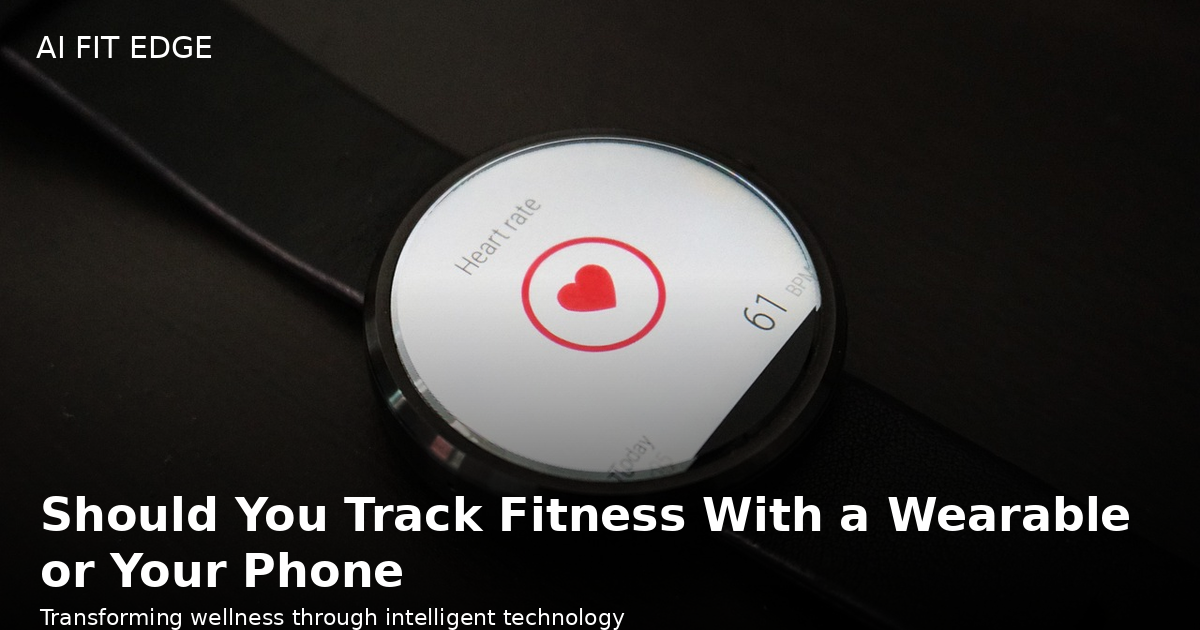
Why the Phone vs Wearable Question Matters More Than Ever
Every fitness journey these days starts with a simple decision that most people make without thinking. You either keep tracking on the smartphone already in your pocket, or you buy a dedicated wearable such as a fitness band. The choice used to feel trivial. Now that workout apps and health platforms are powered by smarter algorithms, the gap between the two approaches has grown into a real fork in the road. Pick the right path and you get accurate sleep, heart rate, and recovery signals that guide your training. Pick the wrong one and you spend money on a gadget that does what your phone already did, or you miss the data that would actually move your progress forward.
This guide walks you through what each option genuinely delivers, what it silently fails to deliver, and how to match the choice to your goals. You will walk away able to decide for yourself, with real criteria instead of marketing hype. Read the whole thing before you spend a single dollar, because the most expensive mistake here is buying twice.
What a Phone Already Tracks Well
Let us start with the option you already own, because the phone is very good at several tasks and you should not pay for what you already have. Modern smartphones come with an accelerometer, a gyroscope, and GPS built in. That hardware powers step counting, distance tracking on runs, and map based routes through fitness apps. For someone who runs, cycles, or walks outdoors, the phone is genuinely excellent.
The phone shines in a few specific ways:
- GPS accuracy for outdoor routes is excellent, and it needs no additional hardware to produce a clean map of your run.
- The screen is large, so live splits, pace, and heart rate from a chest or arm strap are easy to read mid workout.
- It already runs the apps, stores the history, and syncs to your accounts for free.
- Paired chest straps pair instantly and give laboratory grade heart rate for interval work.
If your training happens outdoors, involves movement you can see, and you want the richest set of metrics with no extra purchase, the phone is a strong default. The catch is not what the phone does well. It is what the phone refuses to do at all.
What a Dedicated Wearable Actually Adds
A fitness band such as the Fitbit Air exists for one reason: to sit on your wrist all day and night without annoying you. The phone cannot do this. The Fitbit Air is a small, light, screenless band that costs around ninety nine dollars and is designed around passive tracking. It tracks your steps, your sleep, your heart rate, your skin temperature, and your blood oxygen around the clock because it never needs to leave your wrist. That is the entire point.
The value is not the step count, which your phone can also do. The value is the continuous picture that only a worn sensor can produce. A phone sits in your pocket or on a desk for hours. A worn band measures your resting heart rate every minute of the night, sees your overnight temperature drift, and watches your recovery between workouts. That continuous stream is what turns a gadget into a coach.
Reviewers who wore the Fitbit Air alongside full smartwatches found the band’s heart rate tracking matched the big devices almost exactly, sometimes within a single beat per minute. For sleep scoring, temperature trends, and recovery, the band is not a toy. It is a legitimate health monitoring tool that punches far above its price.
Why Passive Health Data Changes Your Training
The real reason the wearable versus phone debate matters is not about which counts steps better. It is about a category of data that phones simply do not generate well: passive health signals captured while you rest. Here is what that delivers in practice.
Sleep is where your body actually repairs
Recovery does not happen in the gym. It happens while you sleep. A band worn all night tracks your sleep stages, your resting heart rate, and your overnight temperature. Over time you learn which habits wreck your sleep and which ones protect it. You can see that the late workout, the extra coffee, or the stressful day shows up as worse overnight metrics. That feedback lets you make one change at a time and watch the signal improve.
Resting heart rate tells the truth about your effort
Your resting heart rate is one of the most honest signals of how hard your body is actually working. When it trends upward for several nights, you are overtrained, under recovered, or getting sick. A phone cannot give you this because it is not on your body during the night. A band gives you a number every single morning, so you learn to train by your body’s real capacity instead of your calendar.
Temperature and blood oxygen catch what steps miss
The Fitbit Air packs an optical heart rate monitor, a skin temperature sensor, and red and infrared sensors for blood oxygen. These measure your baseline and flag when you drift away from it. A rising overnight temperature can signal the start of an illness before you feel symptoms. Low blood oxygen trends can point you toward a conversation with a doctor. This is proactive health monitoring, and no pocket device provides it.
The Honest Tradeoffs You Must Weigh
Nothing is free, and the wearable path has real compromises. Do not buy one expecting perfection. Here is what reviewers consistently found, stated plainly.
The band is not a perfect exercise tracker
The Fitbit Air has no onboard GPS and no way to start a workout from your wrist. It relies on automatic activity detection and on your phone for routes. In early testing, automatic detection was rough. One reviewer reported the band reading a swim as a walk, and another saw every walk register as a swim until they corrected the activity type manually. Google improved detection with updates, but the lesson stands: a passive band is a health monitor first and an exercise logger second.
If you run intervals that need exact distance and pace, or you train with structured workouts you start deliberately, you still want either a smartwatch or a phone with you. The band shines for daily health and overnight recovery, not for precise run pacing.
The phone still wins at the gym
Inside a gym, your phone is usually the better tool. It holds your workout programs, lets you log sets and reps between exercises, shows you video form cues, and tracks rest timers. A screenless band cannot display a workout plan. Your phone can also pair to equipment and heart rate straps for accurate zone training. So do not frame this as either or. Many serious lifters track their lifting on the phone and wear the band for sleep and daily recovery.
Screenless does not suit everyone
A band with no screen means no quick glance at the time, no call alerts, no notifications. Some people love this because it removes a distraction. Others find it frustrating, missing calls and checking their wrist for nothing. If you want glanceable essentials, a small display like the newer Fitbit Edge bridges the gap without turning into a full smartwatch. Know your own preference before you buy.
How to Decide Which Setup Fits Your Goals
You do not need to solve this generically. You only need to answer one honest question about yourself: what is your primary goal, and what data will actually move you forward? Run through these four profiles and pick the one that sounds like you.
You train outdoors and want route data
Keep your phone as your primary tracker. It nails GPS, routes, and distance. If you later want overnight recovery insights, add a low cost band and let the two work together. Your phone gives the run, the band gives the recovery.
You want to optimize sleep and daily recovery
This is the band’s home turf. A passive wearable worn day and night gives you morning readiness scores, resting heart rate trends, temperature drift, and sleep stages. This profile gets the most value from a band because the phone simply cannot supply this signal.
You lift weights in a gym
Track your sets and reps in a workout app on your phone. Use the band for sleep and daily recovery outside the gym. This combination respects the strength of each tool and gives you accurate lifting logs plus real recovery data.
You want one device to do everything
Then you want a full smartwatch, not a passive band. A modern smartwatch combines a display, onboard GPS, manual workout modes, and sleep tracking. It costs more and needs more charging, but it removes the need to juggle two devices. If simplicity beats maximum recovery fidelity, this is your answer.
My Honest Recommendation
If you already own a capable smartphone, do not rush out and buy a full smartwatch. Start by using the phone for your runs, workouts, and route tracking, which it handles superbly. Ask yourself whether you are actually missing sleep, recovery, and resting heart rate data. If the answer is no, save your money and stay with the phone.
If you find yourself guessing about how recovered you are, waking up tired without knowing why, or training through illness out of ignorance, that is the signal to add a lightweight passive band. A screenless tracker provides the continuous overnight data your phone never will, at a price far below a smartwatch. Wear it for a full week, let the readiness and resting heart rate trends accumulate, and let the data guide your decisions. That single insight, more than any gadget, is what turns daily tracking into genuine progress toward your fitness and health goals.

















