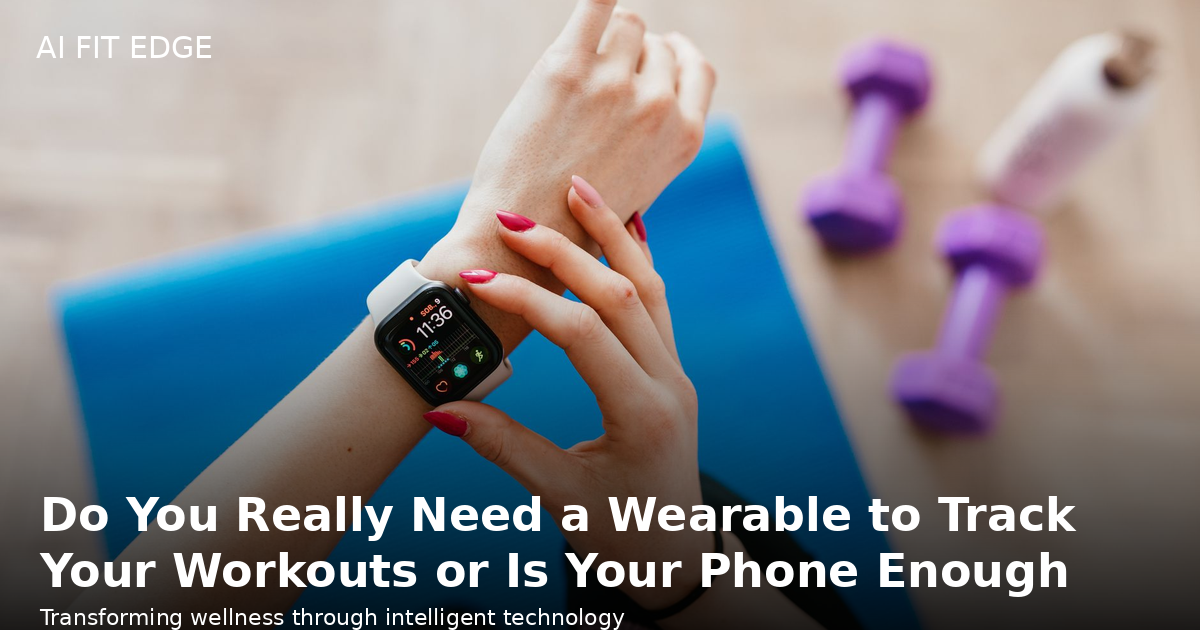
Why the Wearable Question Keeps Coming Up

Every few months the same argument surfaces in fitness forums and group chats. Do you really need a smartwatch or a tracking ring to get the most out of your training, or can your phone do the job? The question matters more in 2026 because the market has split into two very different ways of tracking your body. One camp sells you a device you wear on your wrist. The other uses the camera and sensors already sitting in your pocket. Neither answer is wrong, but the right choice depends on what you actually train for, how much you want to spend, and how much data you honestly want to look at.
This guide walks through the real trade offs between a dedicated wearable and an AI powered phone app. You will learn what each approach measures well, where it falls short, and how to pair the two without wasting money. By the end you should be able to make a confident decision for your own goals instead of following whichever flashy launch video you saw last.
What a Wearable Actually Does Well
A wearable tracker like a Fitbit, Oura Ring, or Garmin has one massive advantage that no phone app can copy. It stays on your body all day and all night, collecting continuous data without you lifting a finger. That passive collection is the reason so many people love them.
Continuous Heart Rate and Resting State
Your resting heart rate, heart rate variability, and overnight recovery scores are the foundation of modern health monitoring. A wrist device reads your pulse constantly, which lets it estimate how hard your cardiovascular system is working during a run, how well you recovered overnight, and whether your training load is trending too high. Phone apps simply cannot see this data because your phone is not touching your body.
This is genuinely useful information. A sudden jump in resting heart rate over several days is often one of the earliest signs that you are under recovering or coming down with an illness. People who train hard rely on these trends to decide whether to push through a session or back off.
Sleep Tracking That Matters
Modern wearables break your night into light sleep, deep sleep, and REM, then give you a readiness score in the morning. For anyone serious about recovery, this is a daily window into how well your body rebuilt itself. The data is not perfect, and no consumer device holds up against a medical sleep lab, but the trends are consistent enough to be useful.
Effortless Cardio Tracking
For running, cycling, and hiking, a wearable with GPS is hard to beat. It logs your route, pace, elevation, and heart rate zones automatically. You strap it on, run, and the work is done. There is no setting up a camera angle or opening an app before you move.
What an AI Phone App Brings That a Wearable Cannot
Here is the twist. Wearables are brilliant at measuring your body from the outside, but they cannot see what you are actually doing. A wrist tracker knows your heart rate went up, but it does not know whether you completed a full squat or a half squat. AI phone apps attack exactly this gap by using your camera.
Rep Counting and Form Feedback
Computer vision apps watch your body move and count each repetition. More importantly, they judge the quality of that movement. An app can tell you that your push up is not going deep enough, that your back is rounding during a squat, or that your knees are caving in on a lunge. This is real time coaching that no wrist device can deliver, because a watch cannot see your joints.
Photo Based Nutrition Logging
Food tracking is where phone apps shine brightest. Instead of searching a database and weighing every ingredient, you snap a photo of your plate and an AI model estimates the calories, protein, carbs, and fat. It is dramatically faster than manual logging, which means people actually stick with it beyond the first week. This is a recurring weak spot for wearables, where food logging still means typing search terms into a small screen.
Comparing Accuracy Across the Two Approaches
Neither tool is accurate at everything, so let us be honest about where each one wins and loses.
- Heart rate and sleep. The wearable wins clearly, because it needs skin contact to read your pulse.
- Repetition counting and form. The AI phone app wins, because it needs to see your body to judge your technique.
- Step counting and calorie burn. Both are estimates, and neither is laboratory accurate. Treat them as rough guidance.
- Free weight training. The phone app wins for counting and form, while a wearable adds useful intensity and recovery context.
- Running outdoors. The wearable wins for GPS, pace, and continuous heart rate.
There is a second layer few people consider, and that is the amount of effort each system needs. A wearable tracks passively all day with zero input from you. A phone app usually requires you to set it up at the start of a workout, point the camera, and keep your phone positioned where it can see you. That extra friction is real, and it matters on days when you already do not feel like training.
The Privacy Angle That Is Easy to Overlook
Health data is among the most sensitive information you own, and the two approaches store it very differently. A wrist wearable normally syncs your metrics to the manufacturer cloud so you can see them in an app. That means your resting heart rate, sleep patterns, and workout history live on a company server, governed by whatever privacy policy you accepted when you set the device up.
A camera based phone app raises a different set of questions because it is pointing at your body and your food. Before you choose, look for apps that process video locally on your device rather than uploading it, that let you delete your data, and that store only the statistics you actually want, never the raw footage. These choices matter more the longer you plan to track your health, because the data accumulates over months and years.
Should You Buy One, the Other, or Both
The honest answer is that it depends on your primary training style and your budget.
Choose a Wearable If You Train Cardio
If your week is built around running, cycling, swimming, or hiking, buy a wearable with GPS and heart rate first. You will get continuous cardio data, sleep and recovery insight, and you will never have to fiddle with your phone mid workout.
Choose a Phone AI App If You Lift Weights
If your main focus is strength training, the ability to count reps and correct your form in real time is more valuable than a heart rate number. An AI phone app can genuinely improve how you train and help you log nutrition, often at no upfront hardware cost.
Pair the Two If You Train Everything
Many serious athletes eventually end up with both. The wearable handles the all day recovery picture, and the phone app handles the movement quality and food during the workout window. This combination gives you the fullest view, but you should only add the second tool after you have actually used the first one consistently for a month. Buying everything at once is how gear ends up in a drawer.
Practical Steps to Decide This Week
You do not need to overthink the decision. Work through this short checklist and the answer will become obvious.
- Write down your three most frequent workouts from the last month.
- If they were mostly running, cycling, or swimming, start with a wearable.
- If they were mostly lifting or bodyweight training, start with a camera based AI form app.
- Set a budget. A wearable costs more up front and may add a subscription, while a phone app works with hardware you already own.
- Check your privacy comfort level and read how each tool handles your data before you commit.
- Use whichever you pick consistently for 30 days before deciding whether you need the other.
The Bottom Line
You do not need to spend a few hundred dollars on a wearable just because everyone else in your feed owns one. The right tool is the one that matches what you actually do and that you will actually use. For cardio and all day recovery, a wearable is genuinely the better buy. For strength training, form feedback, and easy nutrition logging, a camera based AI phone app is often the smarter choice. And for the most complete picture, using both together gives you continuous recovery data and real time movement coaching at the same time.